The Complete Guide to Contemporary IT Security and Infrastructure Solutions
The digitalization of business processes has opened unprecedented prospects for efficiency, development, and innovation, but at the same time has left organizations vulnerable to developing cyber threats, infrastructure weaknesses, and business reliance on technology platforms. Where one security incident can compromise data, hurt reputation, and impede operations, IT security and infrastructure management are now business needs, not technical comforts.
High End Laptops: Professional Computing Power
The laptop computer has come from a convenient on-the-go substitute for desktop workstations to become a primary computing device for professionals in various industries. High end laptops provide performance comparable to desktop computers but with portability demanded by contemporary work styles, from remote work setups to client meetings and travel situations calling for full computing capability anywhere.
Performance specifications establish capability for high-end applications. Processor speed establishes compute speed with next-generation chips providing several cores to manage parallel workloads effectively. RAM size influences multitasking capacity and app responsiveness with professional tasks commonly needing 16GB as an absolute minimum and 32GB or more for heavy use. Storage technology also influences capacity and speed with solid-state drives significantly outstripping conventional hard disks. Graphics performance is important for high-end applications from CAD graphics to video editing needing dedicated graphics processing units.
Connectivity interfaces allow interaction with peripherals and networks needed for work-related tasks. USB-C offers support for newer accessories and charging. Classic USB-A remains compatible with current devices. HDMI allows for external display connections for presentations and increased workspace. Ethernet offers secure wired networking.
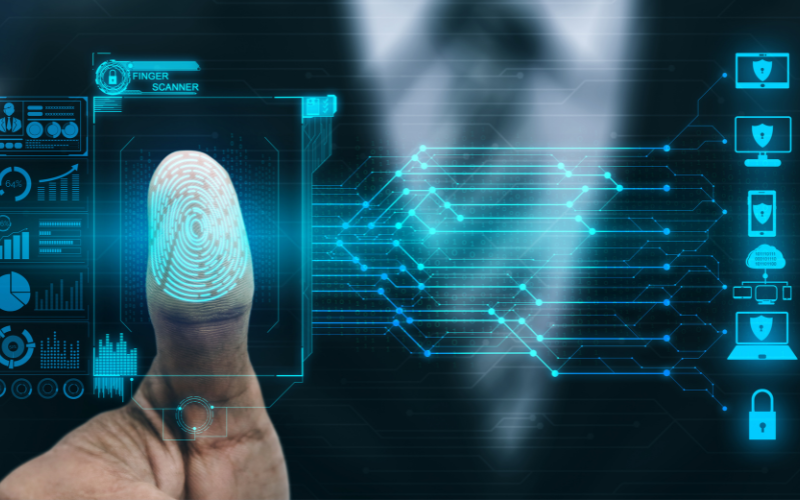
Security aspects shield confidential business information from illicit access. Fingerprint readers support biometric authentication without the use of password vulnerabilities. Windows Hello facial recognition provides another biometric alternative. TPM chips protect encryption credentials and keys. Privacy screens avoid visual snooping in public. Webcam shutters physically mask camera access to thwart illicit surveillance.
Desktops and Laptops Rentals: Flexible Computing Solutions
Not all computing requirements warrants the buying of equipment, especially for short-term projects, seasonal staffing augmentation, or companies wishing to sidestep capital outlay and risks of obsolescence. Rental of desktops and laptops offers adaptable options offering required computing power without the ownership hassles, maintenance issues, or disposal issues when requirements shift.
Rental applications range from various circumstances in which temporary access is financially and pragmatically advantageous. Needs for projects involve computing resources for specified periods. Event technology facilitates conferences, trade shows, and transient operations. Seasonal staffing addresses changing workforce patterns. Testing and evaluation facilitates testing equipment prior to purchase obligations. Disaster recovery delivers backup systems when the main infrastructure is destroyed. Training programs necessitate temporary equipment for training sessions.
Equipment choice by rental vendors provides varied alternatives meeting unique needs. Performance levels from entry-level business computing to top-end workstations meet varied utilization. Operating system options for Windows, macOS, and Linux meet organizational and application standards. Configuration personalization includes memory, storage, and pre-installed software. Peripheral inclusion packages monitors, keyboards, mice, and other peripherals. Quantity versatility meets single units to hundreds at once.
Rental conditions strike a balance between commitment and flexibility. Day- or week-by-week short-term rentals accommodate events and urgent needs. Month-long rentals accommodate projects and seasonal needs. Long-term rentals offer long-term access with possible rent-to-own conversions. Flexibility by the month accommodates changing needs. Early termination clauses avoid paying for unused terms. Extension options cover project delays or scope variations.
Service inclusion covers technical requirements beyond equipment supply. Initial deployment and installation get systems in place for instant use. Support with technical help supports configuration and fault finding. Maintenance and repairs take care of hardware breakdowns without client responsibility. End-of-term pickup streamlines return logistics.
Cost factors measure overall cost above mere rental fees. Rental rates generally depend on equipment details and timeframe. Security deposits guard against damage or non-return by providers. Pickup and delivery charges add to logistics costs. Liability coverage is offered through insurance options. Damage fees incur for non-returned or damaged equipment. Tax effects differ under rental versus purchase accounting.
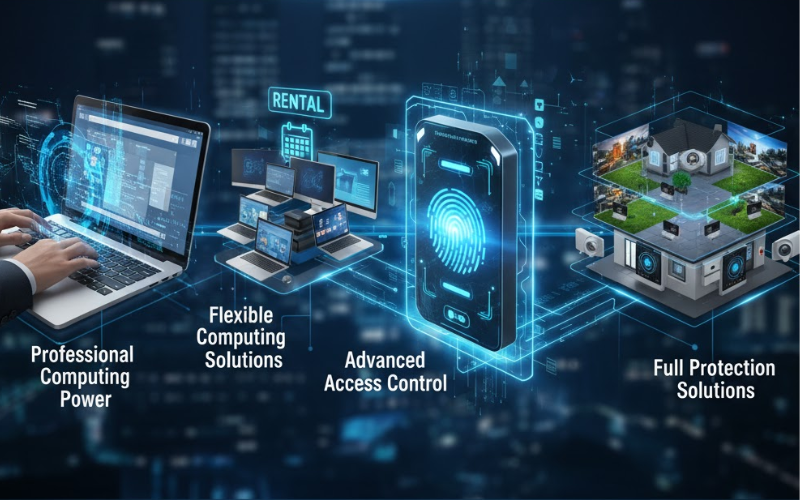
Biometric Home Security Systems: Advanced Access Control
Conventional lock-and-key safety has given way to advanced biometric verification on the basis of singular human features which cannot be replicated with ease, misplaced, or stolen. Biometric residential security systems offer superior safety against unauthorized entry and easy entry for approved residents on the elimination of fumbling with keys or remembering codes.
Biometric modalities recognize people using various physical or behavioral traits. Fingerprint recognition reads individual ridge patterns on fingertips. Facial recognition scans distinct facial features using camera systems. Iris scanning reads distinct eye patterns. Voice recognition recognizes individuals using speech traits. Multi-modal systems use several biometrics that enhance security and accuracy.
System elements collaborate in delivering total access control solutions. Biometric readers take identifying traits at portals. Control panels process authentication decisions and control system functions. Electric locks operate based on successful authentication. Backup batteries provide continued operation during power loss. Connectivity solutions provide remote monitoring and control. Integration options link in with larger security systems.
Installation factors influence both operation and user experience. Proper sensor location provides easy access while ensuring security. Weather protection shields outdoor reader operation. Light sufficiency supports proper image capture for visual biometrics. Connectivity over the network facilitates remote monitoring and access. Power routing delivers consistent electrical supply. Professional installation guarantees correct setup and testing.
User enrollment fills systems with registered user credentials. Initial registration takes biometric templates from all registered users. Family member inclusion grants access to residents. Guest access accommodates temporary authorization for visitors. Template quality influences recognition accuracy. Backup authentication methods give alternatives when biometric fails. Enrollment management adds or deletes users as needs evolve.
Security benefits over the conventional practices cover several exposures. Unlosable passwords eliminate key loss issues. Uncopyable identifiers stop unauthorized copies. Audit trails record all access incidents. Tamper alerts identify physical attack attempts. Remote lockdown allows emergency access denial. Integration with alarm systems offers total protection.
Privacy issues cover data protection needs. Biometric data is stored locally with template storage to avoid centralized databases. Stored templates are encrypted for protection from unauthorized access. No-internet-required functionality preserves privacy for users who care. Data deletion features erase information when users leave. Compliance with relevant regulatory requirements meets privacy legislation. Transparency regarding data processing enhances user trust.
Home Security Security Systems: Full Protection Solutions
Home security is more than just access control and includes intrusion detection, environmental monitoring, video surveillance, and emergency response providing layered protection from a wide variety of threats. Intrusion detection is the basis of most security systems. Door and window sensors alert to unauthorized opening. Motion detectors sense movement within guarded areas. Glass break sensors identify the acoustical signature of breaking glass. Vibration sensors sense attempts at forced entry. Perimeter protection establishes defensive layers prior to intruders entering buildings. Interior protection offers redundant detection in case perimeters are compromised.
Video monitoring offers visual confirmation and documentation of security incidents. Camera coverage guards against entry points, valuables areas, and property lines. Recording features save footage for review. Cloud storage offers remote backup that avoids evidence destruction. Mobile viewing offers real-time monitoring remotely. Night vision offers operation in the dark. Motion-activated recording saves space by capturing only useful footage.
Central control panels integrate system devices and user inputs. Arming and disarming controls the system ‘s working state. Zone management allows selective protection of individual zones. User code administration controls access for household members. System status displays indicate sensor states and warnings. Backup power continues operation in the event of power outages. Tamper protection identifies physical attack attempts.
Smart home integration links security with home automation. Voice control using assistants such as Alexa supports hands-free use. Automated activity such as lighting and lock control adjusts based on security status. Energy management works by adjusting thermostats and lights. Scene creation commands groups of devices. Remote access via smartphone apps offers control anywhere. Third-party integration increases capabilities using ecosystem integrations.
Conclusion
The information-based foundation of contemporary business operations poses both enormous opportunities and great challenges that call for holistic solutions to IT infrastructure, security, and management. To be effective in the technology-driven world today requires more than the purchase of hardware or deployment of point solutions; it takes strategic consideration, professional acumen, and continuous diligence in ensuring systems remain secure, reliable, and attuned to business requirements as technologies change and threats appear.
Those organizations looking to create or expand their IT capabilities gain immensely from contracting with seasoned providers who possess in-depth knowledge in the entire gamut of technology needs from computing hardware to security systems. Emdee sets the example for this holistic approach by providing end-to-end solutions covering high end laptops for professional strength, desktops and laptops rentals for adaptive access to resources, biometric home security systems offering enhanced security, home security security systems offering complete safety, AMC for computer maintenance guaranteeing constant reliability, wireless infrastructure solutions constructing strong connectivity, and managed network infrastructure services ensuring expert management. With expert insight in IT security best practices and established expertise in multiple technology areas, Emdee offers the expertise, resources, and dedication organizations require to establish and maintain secure, reliable IT infrastructure that drives business success while safeguarding against new and emerging cyber threats and operations risks.