Understanding Assembled Desktops in Today's Market
The desktop computing environment has changed significantly in recent decades. Where consumers had limited choice from large manufacturers in the past, the marketplace today is extremely flexible in terms of assembled systems commissioned to particular needs and budgets. Knowing what assembled desktops bring to the table—and what compromises accompany them—supports more informed buying decisions.
Configured desktops are composed of separately chosen elements combined into working systems. Instead of receiving predetermined configurations from manufacturers, customers order processors, memory, storage, graphics capability, and other features according to their specific requirements. This degree of customization provides a number of potential benefits over stock options.
Performance tuning is an added advantage. Varying applications require varying priorities of hardware. Content creators require powerful processors and high memory. Gamers consider high-performance graphics cards. Data analysts need fast storage and enough RAM for large data. Business users might require balanced performance without over-specification. Custom-built systems can be built exactly to suit specific purposes instead of compromising with the nearest available off-the-shelf option.
Cost-effectiveness is the result of cutting out unnecessary elements and spending on what is important. Pre-assembled systems include functions that aren’t necessary to some users and lacking in other areas those same individuals find crucial. Built-to-order systems distribute budgets based on priorities, providing more value for certain applications.
Graphics cards can be replaced for improved gaming performance. Storage can be increased as data increases. Memory upgrades maximize system usefulness. This level of upgradeability at the component level lengthens effective system life and saves initial investment.
Assembled Laptops: The Portable Computing Alternative
While desktops assembled together have established popularity, assembled laptops are a less frequent but more and more possible choice. The laptop sector has historically been dominated by key players providing pre-set configurations with little room for customization. Yet, there are a number of factors altering this situation.
Some producers now sell configurable laptops in which consumers choose within compatible ranges. Not as open to modification as assembling desktops, they offer more possible customization than standard laptop purchases. Processor selection, memory settings, storage types and sizes, and display selections are typically possible to define to assemble systems more in line with targeted requirements.
The advent of barebone laptop systems—shells with motherboards on which consumers insert processors, memory, and storage—provides more assembly-like experiences. These systems are less prevalent than pre-assembled versions but cater to users who want most control over specifications and component choice.
Configurable choices allow reaching preferred performance profiles without the cost of unnecessary features or compromises in essential areas.
The Assembled PC Advantage: Component Selection and Integration
Knowing what makes quality assembled systems better than budget builds involves looking at component choice and integration procedures. Not every assembled PC is of the same quality, performance, or reliability.
Compatibility checking avoids problems that afflict poorly designed builds. Modern computing entails intricate interactions between components. Memory needs to be compatible with motherboards and processors. Power supplies need to provide enough clean power for system needs. Cooling needs to carry thermal loads. Storage interfaces need to be compatible with motherboard capability. Professional builders check compatibility extensively beforehand and during assembly
Integration quality influences system longevity and stability. Cable management enhances airflow and maintenance access. Application of thermal paste has an effect on processor cooling. Firmware setup maximizes performance and compatibility. Skilled assemblers pay attention to these subtleties that separate good systems from bad ones.
Testing and quality control catch problems before systems are in users’ hands. Thorough testing under different loads confirms stability. Stress testing finds heat or power problems. Driver installing and setting up causes all parts to operate right. Professional assembly processes have strict testing procedures that amateur builders might forgo.
Desktop Assembled PC: Use Cases and Applications
Various users have enormously diverse computing requirements. Keeping in mind typical usage scenarios assists in considering whether built desktops are appropriate for a given case and how computers ought to be set up.
Content creation requires plenty of processing power, plenty of memory, and frequently, specialized graphics support. Photo editing requires color-accurate monitors and plenty of memory to accommodate large files. Audio production demands low-latency interfaces and decent processing power. Configurable systems can emphasize components important to particular creative workflows.
Gamers is a significant assembled desktop market segment. Gamers require powerful graphics cards, quick processors, good cooling, and sensitive displays. The budget prioritizes graphics support over everything else. Upgradeability is important since new games come out with more demanding requirements. The gaming community is well aware of optimal configurations for various performance levels and budgets.
Professional and commercial applications have a broad range. Software development can require large amounts of memory and multiple screens. Financial analysis is enhanced by processing power and large data that needs rapid storage. Routine office use demands solid systems with no more than required specifications. Business constructions often value dependability, support, and cost of ownership over raw performance.
Home and consumer use encompasses varied requirements. There are users who desire multi-purpose systems that can handle web surfing, productivity applications, and media viewing. Others require strong machines for hobby-level creative activity or light gaming. Budget tends to control choices more than outrageous performance. Assembled PCs can provide value by correlating capability with real needs instead of hyping irrelevant specifications.
Specialized programs occasionally require special configurations. Scientific computing requires particular processors or the ability to parallel process. Machine learning appreciates several graphics cards that can handle computation. Data analysis may value storage and memory requirements over graphics. Trading applications require dependability and several monitors. Assembled PCs better fit these specialized needs than off-the-shelf components.
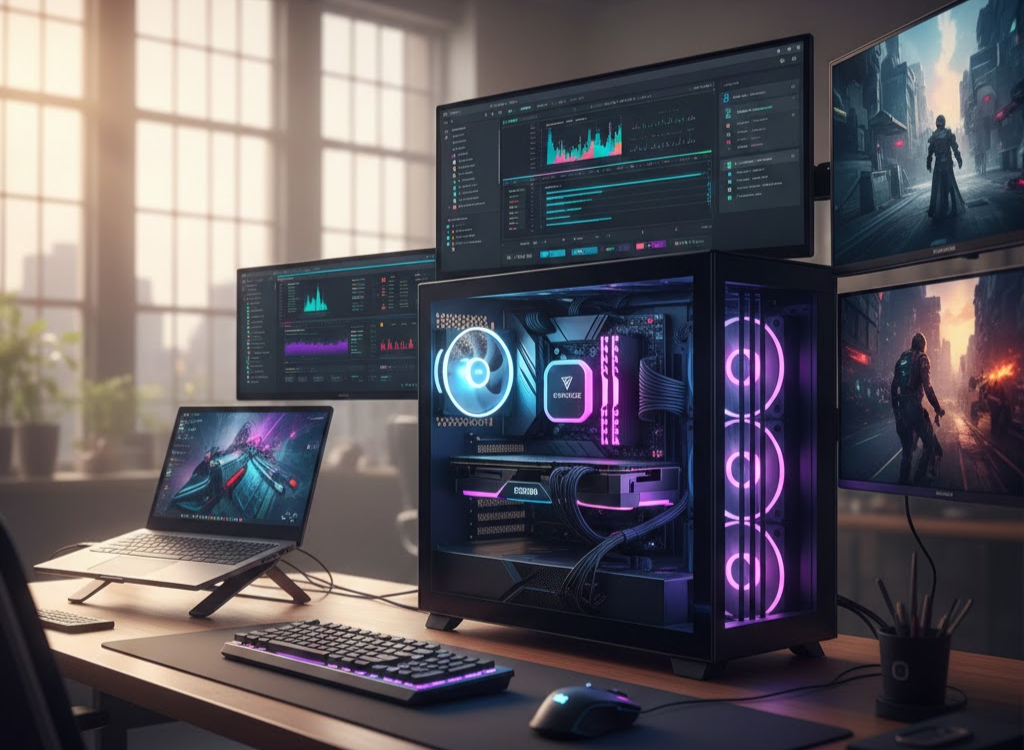
Assembled Desktop Computer: The Building Process
Knowledge about how built desktops are made offers insight into differences in quality and aids in placing proper expectations for those who are looking at taking this route.
Component choosing starts with knowing needs and price. What will the system be used for? What level of performance is required? What is the budget? These questions inform component decisions. Research determines choices within budget that fit requirements.
Assembly refers to physically combining components into working systems. Processors are installed in motherboard sockets. Memory modules are inserted in RAM slots. Storage units are connected through corresponding interfaces. Graphics cards are plugged into PCIe slots. Power supplies are connected to all units. Cooling units are attached to processors and case fans are mounted for airflow. Cable management keeps connections organized.
Initial setup involves BIOS configuration, operating system installation, driver installation, and firmware updates. BIOS configurations tweak performance and facilitate features. Operating system installation establishes the software base. Drivers facilitate proper hardware operation. Updates fix security flaws and enhance compatibility. This setup stage affects system stability and performance.
Testing verifies everything works correctly. Boot testing confirms the system starts properly. Stability testing identifies issues under load. Performance testing validates expected capabilities. Temperature monitoring ensures adequate cooling. This testing catches problems before systems enter service.
Buy Assembled Desktops and Laptops: Vendor Selection
Assembled system vendors are the focus of specialized computer stores and system builders. Vendors will usually have extensive component choice, informed personnel, and exposure to different configurations. Vendors know about compatibility problems and can suggest good specs for a variety of uses. Warranties and support differ but are reasonable by nature. Pricing is based on both component price and assembly/value of service.
Some manufacturers’ online configurators enable the specification of numerous components when buying complete systems. This merged method offers manufacturer parameters for customization. The systems ship was assembled and tested with manufacturer warranty included. Pricing is inclined toward high-end relative to fully custom systems but comes with convenience and support.
Local computer stores usually provide assembly. Component availability can be more restricted than specialized assemblers, and proficiency ranges significantly between stores. Yet, local familiarity can offer ease for support and servicing. Pricing is quite diverse based on shop functionality and overhead.
Do-it-yourself assembly offers greatest control and potentially lowest cost. But this method entails technical expertise, time commitment, ability to troubleshoot, and risk acceptance. Component warranty claims need to be addressed case by case. There is no one vendor that offers system-level support. This choice is best for technically savvy users who are okay with complexity.
Corporate IT organizations often build systems for organizational consumption. This strategy provides specification control, component procurement, and assembly control. But it needs internal resources and talent. Economics only works at specific volumes.
Conclusion
The choice between pre-assembled and pre-built systems is based on considering a number of factors unique to specific situations. Assembled desktops and laptops hold strong attraction for users with unique needs, those who prefer customization and upgradability, and applications where optimization provides real benefits. These benefits require consideration such as vendor selection significance, possible increased initial complexity, and the requirement for educated component choice.
For many users, assembled systems deliver superior value compared to pre-built alternatives. The ability to optimize specifications for specific applications, eliminate unnecessary components while investing in what matters, and maintain upgrade paths that extend system usefulness justifies the assembled approach. Gaming enthusiasts, content creators, and users with specialized requirements particularly benefit from customization flexibility.
Business users increasingly appreciate the benefits of assembled systems. Standards can be set on favorite components, configurations optimized for particular functions, and known-vendor relationships, and value accrues beyond basic cost-of-acquisition considerations. Support, dependability, and cost of ownership over the life of the product enter into decisions alongside purchase prices.
Emdee is experienced in offering well-configured assembled desktops and laptops that maximize performance, value, and reliability for various computing applications. Recognizing that various users have extremely varied needs, Emdee operates consultatively to learn about particular applications, budgetary constraints, and priorities prior to suggesting proper configurations. Parts selection prioritizes quality, compatibility, and proper performance levels over lowest cost or highest specifications. Professional assembly, extensive testing, and overall support guarantee systems operate dependably from shipping through years of useful service. Whether equipping imaginative pros, game players, business processes, or specialized uses, Emdee provides pre-assembled computing solutions that offer the appropriate capabilities at reasonable costs supported by informed service.