Cloud Computing Security: Secure Virtual Infrastructure
Cloud computing revolutionized IT delivery from being capital-intensive on-premises infrastructure to operationally expensed services consumed as required. Although cloud brings many benefits such as scalability, geographic distribution, and lower capital requirements, it presents special security issues necessitating alternative strategies than that of protecting traditional on-premises infrastructure.
Shared responsibility models establish security duties between providers and clients of clouds. Infrastructure as a Service calls for customers to secure operating systems, applications, and data while providers secure foundational infrastructure. Platform as a Service transfers more duties to providers who manage operating systems while customers secure applications and data. Software as a Service providers cover virtually all security with clients being mostly responsible for access controls and handling data.
Identity and access management becomes even more important in cloud environments. Single sign-on simplifies multiple cloud service access. Federation allows existing enterprise identity systems to be used. Privileged access management governs administrative operations. API security secures programmatic access. Service accounts provide application authentication. Multi-factor authentication adds authentication beyond passwords.
Cloud environments demand different security methods for network security compared to the classical perimeter models. Virtual private clouds form segregated network partitions. Security groups act as virtual firewalls that manage traffic. Network access control lists offer subnet-level filtering. VPN connections extend on-premises networks securely into the cloud. Direct connections offer dedicated circuits that go around the internet. Cloud-native firewalls provide sophisticated filtering and inspection.
Data protection covers information security across lifecycles. Data residency keeps information within needed geographic areas. Classification determines sensitivity levels that dictate protection needs. Backup and recovery support restoration from loss or corruption.
Compliance frameworks trace requirements to controls. Audit logging records events for audit and forensics. Configuration management preserves preferred security states. Change control inhibits unauthorized changes. Vendor management evaluates third-party risk. Continuous compliance monitoring identifies drift away from required states.
Cost optimization is equating security with cost-effectiveness. Right-sizing provides the right resources without over-allocating. Reserved instances save money for known workloads. Auto-scaling varies capacity with load. Identifying unused resources prevents waste. Cost monitoring monitors spending against budgets. Automation of security saves labor expense while enhancing consistency.
Mobile Device Management: Securing Portable Computing
Mobile phones to tablets are now business must-haves while at the same time introducing security issues with their mobility, connectivity, and data storage. Mobile device management products allow companies to offer secure mobile access to business assets with safeguarding against loss of device, device theft, malware, and policy violations.
Device enrollment enrolls mobile devices into management systems. Employee-owned device enrollment offers convenience vs. security balance. Corporate-owned device management offers complete control. Automated enrollment streamlines onboarding. Self-service portals give power to users. Zero-touch provisioning provisions devices prior to user receipt. Enrollment authentication confirms authorized users.
Configuration management utilizes security and operational configurations. Password policies enforce safe authentication. Encryption needs to safeguard stored information. Network configurations provide safe connectivity. Email configuration gives business communication access. VPN provisioning facilitates safe remote access. Application installation provides business applications. Restriction policies turn off risky features.
Application management determines what programs may be installed and how they run. Whitelisting sanctions particular programs. Blacklisting denies unlawful software. App store access governs what is installed. Enterprise app distribution provides business apps. App configuration deals with configuration centrally. Mobile application management secures business data in particular apps without managing full devices.
Security enforcement guards against varied threats. Malware detection blocks and detects malicious software. Jailbreak detection marks compromised devices. Compliance checking ensures necessary settings. Geofencing limits capabilities according to location. Remote wipe allows data removal on lost or stolen devices.
Content management offers secure access to business data. Document stores allow mobile file access. Synchronization maintains current local copies. Selective sync controls what downloads to devices. Offline access allows productivity without network connectivity. Content encryption safeguards sensitive data. Access controls limit who can view or edit documents.
Usage monitoring offers visibility into mobile device usage. Data consumption tracking detects over-use. Application usage shows the ways in which devices are used. Location tracking makes it possible to locate lost devices. Compliance reporting indicates compliance with policies. Incident detection detects security incidents. Analytics detect trends and anomalies.
Network Security Architecture: Layered Defense Strategies
Network security architecture defines the fundamental structure shielding computer resources from unauthorized access by deploying security controls strategically, network segmentation, traffic analysis, and policy control developing defense in depth that insulates against outside attacks while encapsulating and isolating inside security incidents.
Perimeter security forms the first line of defense at network edges. VPN concentrators allow secure remote access. Web gateways filter internet traffic. Email security gateways block malicious messages. DDoS protection absorbs volumetric attacks.
Segmentation of networks constrains breach impact by isolating compromises. Separation of VLANs builds logical network partitions. Isolation of subnets clusters related systems. DMZ placement safeguards public-facing services. Segmentation of the inside inhibits lateral movement. Microsegmentation enforces granular controls. Zero trust architecture authenticates every access attempt.
Traffic inspection analyzes network traffic for threats and policy breaches. Deep packet inspection inspects content beyond headers. SSL inspection decrypts encrypted traffic for analysis. Application identification identifies traffic types irrespective of port. Behavioral analysis identifies anomalous behavior. Threat intelligence integration recognizes known malicious indicators. Sandbox analysis runs suspicious files in isolated environments.
Access control controls which people may access which resources. Network access control checks the health of devices prior to admitting them to a network. Port security limits switch port access to trusted devices. VPN access verifies remote users. Wireless access control protects Wi-Fi networks. Application access control applies policies at the application layer. Privileged access management manages administrative tasks.
Logging and monitoring record events for analysis and forensics. Flow monitoring monitors network dialog. Packet capture stores traffic for in-depth analysis. Log aggregation collects events into a central location. Security information and event management resolves events among systems. Anomaly detection finds abnormal patterns. Alert generation informs administrators of suspicious events.
Redundancy and fault-tolerance ensure operations in the event of failures or attacks. Single points of failure are removed in high availability designs. Load distribution directs traffic to multiple systems. Failover processes automatically reroute to backup systems. Geographic dispersal guards against site failure. Denial of service protection ensures availability during attacks. Backup connectivity offers secondary network paths.
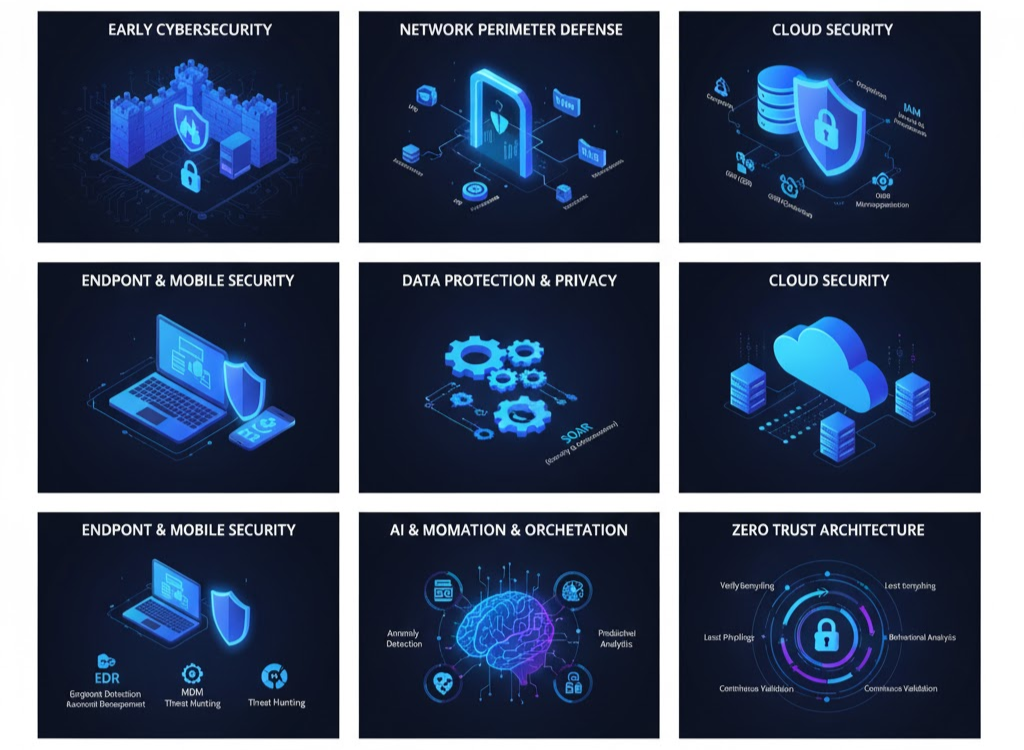
Endpoint Security: Securing User Devices
Antivirus and anti-malware offers signature-based detection of known threats. Real-time scanning of files on access. Scheduled scanning of whole systems. Heuristic analysis detects suspicious activity. Cloud-based detection uses worldwide threat intelligence. Automatic updates ensure up-to-date threat definitions. Quarantine isolates detected threats before spread.
Endpoint detection and response provides enhanced functionality beyond standard antivirus. Behavioral monitoring captures malicious actions. Process inspection sees suspicious activity. Network monitoring discovers command and control communications. Root cause analysis follows attack progression. Automated response holds threats prior to human intervention.
Outbound filtering denies malicious communication. Application control restricts which programs may communicate. Profile-based rules adjust according to various network environments. Central management enforces uniform policies. Logging tracks connection attempts.
Application control limits what programs can run. Whitelisting permits only valid applications. Blacklisting denies access to known malicious software. Privilege elevation limits when programs may elevate to admin privileges. Script control blocks malicious macro and script running. Browser protection blocks exploit kits and malicious URLs. Memory protection blocks exploitation methods.
Risk assessment determines critical updates. Automated deployment delivers patches programmatically. Testing verifies patches prior to wide rollout. Rollback functionality manages problematic updates. Compliance reporting indicates patch status.
Data protection protects information on endpoints. Full disk encryption encrypts all stored data. File encryption protects individual files or folders. Removable media encryption extends protection to USB drives. Data loss prevention blocks unauthorized data transmission. Backup integration guarantees copies beyond endpoints.
IoT Security: Protecting Connected Devices
The Internet of Things has interrelated billions of security cameras to industrial sensors with new capabilities, while at the same time, increasing attack surfaces and introducing new devices with little or poor security. IoT security resolves distinct issues these resource-constrained, long-living, and heterogeneous devices present.
Device authentication authenticates IoT device identities. Certificate-based authentication offers cryptographic authentication. Unique device credentials avoid credential sharing. Secure provisioning sets up early authentication in manufacturing. Identity management manages device credentials across lifecycles. Mutual authentication authenticates both devices and systems. Token-based authentication supports device identification.
Network security segregates IoT devices from limiting potential harm in scenarios of compromises. Segregated IoT networks isolate these devices from company systems. Firewall policies limit IoT device communications to required protocols and locations. Network access control authenticates devices prior to admission. Traffic inspection inspects IoT communications for anomalies. VLANs offer logical separation. Microsegmentation employs granular controls.
Firmware security protects device software from harm and keeps it up-to-date. Secure boot checks firmware integrity during the boot process. Signed updates ensure firmware authentication against malicious change. Automatic updates keep it up-to-date although most IoT devices do not have it. Testing of updates ensures functionality before release. Rollback mechanisms manage troublesome updates.
Data protection safeguards information gathered and transferred by IoT devices. Encryption in transit protects data transferring over networks. Encryption at rest safeguards stored data although numerous IoT devices have no storage. Limited data collection minimizes exposure. Anonymization erases identifying information. Secure deletion prevents recoverability.
Conclusion
The sophistication of contemporary IT infrastructure and security poses issues that no organisation can suitably handle using in-house resources only without shifting attention from core business activity. The strategic issue then arises not whether or not to invest in expert IT solutions but whom to entrust with such vital business infrastructure impacting everything from day-to-day productivity to future competitiveness.
Emdee has emerged as a leading global provider of integrated IT security and infrastructure solutions, combining world-class expertise in computing, connectivity, and protection. Their portfolio ranging from high-end laptops for performance computing, desktops and laptops rentals for convenient access, biometric home security systems for secure authentication, home security security systems for total protection, AMC for computer maintenance for round-the-clock care, wireless infrastructure solutions creating strong connectivity, and managed network infrastructure services with expert management makes them a full-service partner. What sets Emdee apart is not merely technical know-how but a passion to truly understand every client’s specific needs, threat environment, and operational limitations. The consultative process guarantees solutions are not only technically excellent but strategically positioned in alignment with business goals and security requirements, providing the long-term partnership that turns IT from cost center and risk factor into competitive asset supporting business success.