
Keeping Computing Hardware in Good Condition for Long Life and Reliability
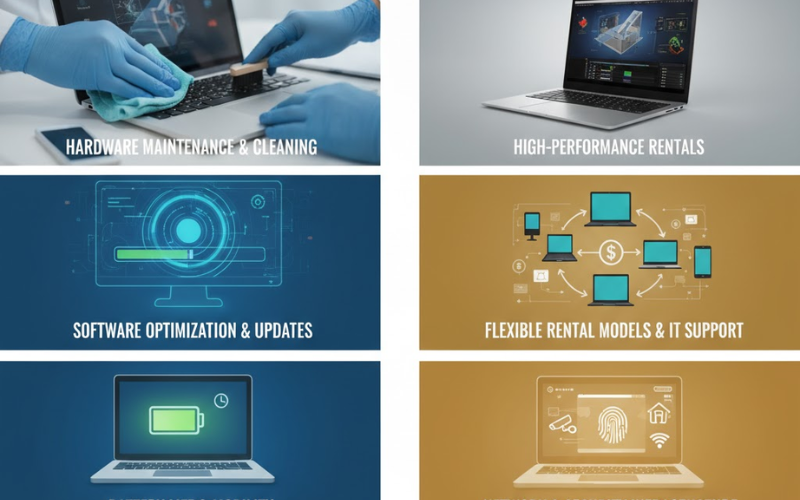
Debris on keyboards hinders key functionality. Contamination on monitors lowers visibility and makes unfavorable impressions in professional environments. AMC laptop computer maintenance involves routine cleaning that forestalls such problems while keeping professional device appearance.
Software maintenance resolves performance slowing down that occurs over time as systems get cluttered with unwanted programs, cached files, fragmented files, and configuration issues. Regular optimization clears digital clutter, defrags storage, updates software, and reconfigures systems to regain like-new speed. These maintenance operations halt the slow-down that users tend to blame on aging hardware when program problems are responsible for performance slowing.
Battery care extends laptop mobility features that separate them from desktop computers. AMC laptop computer care involves battery condition monitoring, charging habit education, and prompt replacement that keeps mobility capabilities. People who are angered by laptops that expire after thirty minutes on a battery often fault aging equipment when replacing the battery would bring hours of mobile use.
Updates for drivers and firmware keep hardware pieces running at peak performance with newer software and secure against known vulnerabilities discovered. Updates are complicated and can install wrongly with catastrophic results. AMC laptop computer maintenance technicians perform updates professionally, checking compatibility, system backups prior to modifications, and troubleshooting any problems that arise. This skill avoids the issues that discourage users from conducting required updates personally.
High-Performance Computing for Professional Use
Professional activities now more and more require computing capacity previously reserved for specialized workstations or servers. Video production, three-dimensional design, data processing, software development, graphic design, and many other knowledge work activities necessitate processing capacity, memory storage, and graphics that entry-level devices cannot provide. High-end laptops serve these intensive applications with portability fixed workstations can’t match.
The performance features that differentiate high end laptops from typical machines include several different dimensions. Processors on high end machines generally involve more cores operating at higher speeds, providing significantly higher computational output. Memory sizes of 16, 32, or even 64 gigabytes support large datasets, multiple processes at once, and memory-intensive processes that would bog down machines with 8GB or less. Storage solutions based on high-speed NVMe solid-state drives instead of standard hard disks remove storage bottlenecks that limit system responsiveness as a whole.
High end laptop display quality is another important differentiator. Accuracy of colors, resolution, brightness, and contrast are all very important for professionals whose work output individuals see on different devices and media.The expense of device breakdown—lost data, lost deadlines, lost productivity during repair—can be much higher than price differences between reliable premium products and unreliable low cost ones. For professionals whose living depends on their computing hardware, reliability is not a luxury but a requirement.
Grasping Rental Models of Accessing Technology
Desktops and Laptops Rentals have become mass-market solutions providing flexible, affordable access to technology for a wide range of applications. The value proposition of the rental model comprises a number of strong selling points: fixed monthly fees in lieu of unpredictable capital outlays, lower obsolescence risk since equipment is refreshed routinely, support and maintenance built in to lower the cost of operation, and ability to scale capacity higher or lower as circumstances change.
The economics of Desktops and Laptops Rentals are especially appealing for organizations with fluctuating capacity requirements, constrained capital budgets, or preference for the cost savings of operational expense over capital expense. Instead of buying equipment which is idle during off-season periods or is found lacking during peak demand periods, rental models continuously have right-size capacity. The cash flow benefits of amortizing costs over rental cycles instead of forking out substantial initial amounts enhance financial flexibility and keep capital available for other investments.
Inclusion of maintenance and support within rental agreements solves important pain points associated with ownership models. Technical troubles, hardware malfunctions, software issues, and routine support requirements take up valuable time and resources when handled internally or through individual service contracts. Rental vendors usually encompass full support, maintenance, and repair services that deliver users the functional, supported equipment without having to deal with support intricacies or handling vendor relationships directly.
Technology refresh cycles increase unabated as advances in performance, emerging functions, and evolving requirements rapidly make equipment obsolete for modern requirements. Organizations that buy devices become tied into depreciation schedules and cost constraints that cause replacement long after optimal refresh timing. Desktops and Laptops Rentals generally feature periodic piece-of-equipment refreshes that keep users productive with current-generation technology instead of outdated, increasingly under-capable devices that damage productivity and user satisfaction.
The ability to quickly shift capacity as organizational requirements change is another advantage of the rental model. Increased staffing means immediate provisioning of equipment; project endings or layoffs result in surplus capacity. Ownership models flail at this variation, resulting either in surplus capacity carrying costs or frantic equipment procurement during periods of expansion. Rental arrangements adjust in both directions seamlessly, adapting capacity exactly to existing requirements with no ownership model inertia and friction.
Future Trends in Computing and Infrastructure
Technology development keeps speeding up with various trends vowing to revolutionize computing experiences, infrastructure needs, and access models in the next few years. Knowledge of these trends assists in making informed decisions today while anticipating shifts that will redefine technology environments.
Cloud computing persists in moving computing and storage away from local machines to distant data centers accessed through internet connections. This movement minimizes local computing needs while maximizing bandwidth requirements and inducing reliance on connectivity. Wireless infrastructure solutions need to deliver capacity and reliability sufficient for cloud-based workflows where local computing resources become useless if network connectivity is lost.
Edge computing is a counter-trend in taking processing near to users and sources of data to minimize latency, enhance reliability, and counteract bandwidth limitations. Instead of routing all data to remote cloud servers, edge computing locally or regionally processes data. Distributed processing involves more advanced local infrastructure but provides performance and reliability benefits for applications sensitive to latency and environments with poor connectivity.
Artificial intelligence integration revolutionizes computing experiences by providing intelligent aid, automated decision, and improved capabilities across applications. AI-based features increasingly define high-end devices from low-end counterparts as neural processing units and software optimizations make it possible for advanced on-device AI that was previously cloud-dependent. Top-of-the-line laptops with separate AI acceleration hardware bring capabilities no software-only solutions can touch.
5G connectivity holds the potential for wireless bandwidth rivalling wired connections while lessening latency and facilitating extensive device connectivity. This revolution will support new categories of applications while lessening reliance on wired infrastructure. Yet, 5G deployment is still in a state of incompleteness with coverage holes, mostly in rural and developing areas. Wireless infrastructure solutions need to close existing and future paradigms of connectivity amidst lengthy periods of transition.
Augmented and virtual reality applications demand computing, graphics, and wireless bandwidth that mainstream devices today find hard to provide. As the applications ripen and usage increases, device demands will become more stringent. High-end laptops with strong graphics, powerful processing, and good displays place users in front of new categories of applications that entry-level devices cannot adequately handle.
Conclusion: Empowering Success Through Strategic Technology Access
Access to technology essentially determines personal opportunity and organizational ability in today’s society. The divide between people with sufficient technology and those that don’t directly correlates to opportunity divides impacting education, employment, entrepreneurship, and involvement in modern social and economic systems. Increasing access through rental schemes, managed services, and professional assistance makes technology’s advantages available to people beyond those with considerable capital and technical ability.
Professional work, creative output, and entrepreneurial activities that weaker machines cannot facilitate are supported by high end laptops. Performance distinctions between high end and low end equipment turn into productivity distinctions, capability distinctions, and finally result distinctions that make it worthwhile to invest in the right equipment for serious use. Appreciating these performance consequences enables individuals and organizations to make smart choices weighing costs against ability to succeed.
Desktops and Laptops Rentals offer flexible, affordable access eliminating capital hurdles with maintenance and support that minimize operational complexity. Such access is most suited to companies with minimal capital, fluctuating requirements, or preference for operating expense models. The ability to grow capacity smoothly with evolving requirements gives operational flexibility that conventional ownership models cannot rival.
Strong infrastructure via professional wireless infrastructure solutions and managed network infrastructure services is the connectivity platform that today’s work, communication, and digital experiences rely on. Weak infrastructure causes infuriating experiences that squander time, constrain capabilities, and erode productivity. Investing in the right infrastructure is many times more cost-effective than tolerating the hidden expense of poor connectivity and reliability.
Full security through biometric home security systems, professional home security security systems, and adequate network security practices guards individuals, assets, and information from increasing threats. Investment in security avoids losses many times the investment while allowing a sense of peace of mind that improves quality of life and supports concentration on productive pursuits instead of continuous lookout and anxiety.
Professional maintenance by AMC laptop computer maintenance services prolongs equipment life, keeps it at the right performance level, guarantees security, and decreases unplanned breakdowns that interfere with work and result in loss of valuable time. The discipline and skill that professional maintenance entails is much more dependable than people’s good intentions that inevitably succumb to competing priorities and technology constraints.
For people and businesses aiming to optimize value from technology investments via strategic access to high end laptops, adaptable Desktops and Laptops Rentals, solid wireless infrastructure solutions, expansive home security security systems encompassing biometric home security systems, expert managed network infrastructure services, and dependable AMC laptop computer maintenance, Emdee provides solutions that enable success through considerate technology access and support that is congruent with varied needs and situations.